

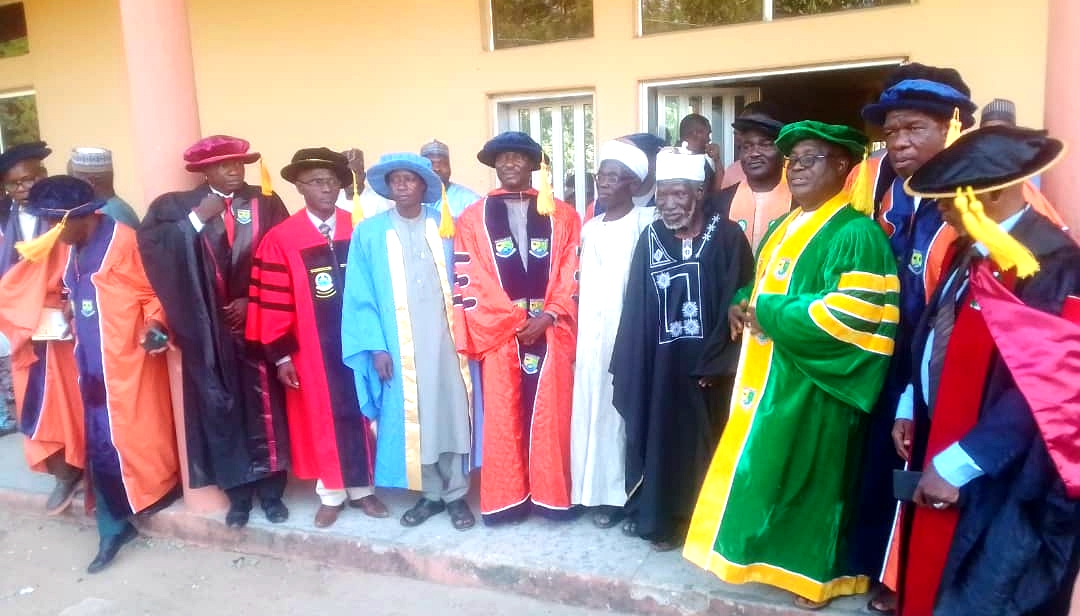
By John Wada-Lafia
Prof. Joseph Ibbih, Professor of Development and Applied Economics at the Nasarawa State University, Keffi (NSUK), says consulting communities on their pressing needs before executing projects is key to development.
He stated this while delivering the University’s 64th Inaugural Lecture on Thursday in Keffi Local Government Area of the state.
Our correspondent reports that the topic of the lecture was: _”From Plans to People: Policies, Projects, and the Nigerian Quest for Shared Prosperity.”_
According to Ibbih, for Nigeria to experience steady developmental growth, projects must be based on priorities, and the most important priorities are those of the host communities.
“It’s not just to walk over and say, ‘I’m going to do this, I am going to do that.’ If anything I’m doing, it must capture this essence: the people are the heart, at the centre of that. Our governments should think in that direction,” he said.
He noted that to entrench inclusiveness, Nigerian governments must adopt a bottom-up approach, which is an inclusive approach that involves people deciding what they want.
“You have done your campaign, you have won election, come to them and in fact, even during electioneering campaign, that’s what the government should be saying: We discovered this is your need, we will do it when we come.
“It is better to just come and say, ‘We will build airport when the people don’t need the airport.’ That’s a top-down approach, deciding on what you should do and doing it for the people whether they like it or not. That approach does not foster development. Bottom-up approach does,” he said.
He explained further that any development must be measurable through what he termed the PPPP framework, anchored on planning, policy, projects and people.
According to him, credible plans must identify real needs, set priority targets and assign responsibilities, while policies must be coherent, projects must be maintained, and people must experience real improvement in welfare and livelihood for a country to record sustainable development.
In her remarks, Prof. Sa’adatu Liman, Vice Chancellor of NSUK, represented by her Deputy Vice Chancellor in charge of Academics, Prof. Maikano Ari, lauded the lecturer for the topic, which she said could not have come at a better time, given Nigeria’s underdevelopment since independence.
“Nigeria is a country that is not short of plans from independence to date. We have had development plans, visions, agendas, and reforms. Yet, the critical question remains: To what extent have these plans translated into better lives for the people?
“To what extent have policies and projects delivered shared prosperity, reduced poverty, created jobs, and improved the livelihood and the wellbeing of ordinary Nigerians? That is the question Professor Ibbih has devoted his scholarship to answering by moving the conversation from plans to people,” she said.
She noted that development is not measured by the beauty of policy documents or the number of projects commissioned, but by the impact on human life.
“True prosperity is shared prosperity. Prosperity that reaches the farmer, the trader, the student, the youth, and the vulnerable. This lecture therefore speaks directly to the core mandate of the university, knowledge for development.
“It challenges policymakers, practitioners, and scholars alike to ensure that policies are people-centred, that projects are well-implemented, that growth is inclusive, sustainable, and just,” she added.
